
The Power to Choose: How Resilience Shapes Your Success

By William F. Nazzaro, founder of The Time to Lead Institute, leadership expert, performance and executive coach, and trusted advisor to leaders navigating transformation and cultural change.
One conversation can change everything.
The phone rings. You expect just another call. Instead, a single sentence shatters your reality—your future, rewritten in an instant.
You can’t always control what happens. But you can always control what comes next. I don’t just believe this—I’ve lived it.
When Life Throws a Curveball
Twenty years ago, I thought I was on the right path. Then, out of nowhere, I lost my job. One conversation and it was gone—the career I had built was erased in an instant.
At first, I froze. My mind raced with worst-case scenarios. The panic was so consuming that I got lost on my drive home—on a route I had driven for over five years. That’s how disoriented I was. The weight of uncertainty was crushing.
But then, through the noise of my thoughts, a single realization br...
Think You’re Making Smart Decisions? Your Brain Might Disagree

By William F. Nazzaro, founder of The Time to Lead Institute, leadership expert, performance and executive coach, and trusted advisor to leaders navigating transformation and cultural change.
Have you ever made a snap decision that felt right in the moment but later turned out to be completely wrong? Or spent too much time overanalyzing something trivial?
Welcome to the reality of how your brain actually works.
Daniel Kahneman’s Thinking, Fast and Slow, breaks down the science of decision-making, revealing why even the smartest leaders fall into cognitive traps. It all comes down to two competing thinking systems that run the show: one is lightning-fast and intuitive, and the other is slow and deliberate. Both are essential. And both can trip you up in ways you don’t even realize.
System 1: Your Brain’s Autopilot (Fast, but Often Wrong)
System 1 is your gut reaction. It’s the part of your brain that jumps to conclusions, fills in gaps, and makes rapid-fire decisions without consci...
No Title? No Problem: Why Real Leaders Don’t Need a Desk Plate

By William F. Nazzaro, founder of The Time to Lead Institute, leadership expert, performance and executive coach, and trusted advisor to leaders navigating transformation and cultural change.
The Illusion of Authority: The Position Myth
Often, emerging leaders believe that authority comes from a job title, thinking that a promotion will instantly command respect and compliance from their teams. This myth can be particularly damaging for newcomers who may feel powerless without a formal designation, hindering their ability to influence and lead effectively from the start. Conversely, established leaders might rely too heavily on their titles, potentially stunting their ability to lead and connect authentically with their teams.
Leadership is not derived from titles but from the actions and decisions one makes. True leadership means stepping beyond the confines of job descriptions to actively shape a positive, impactful environment.
The Misplaced Faith in Information: The Knowledge M...
Understanding "The Law of the Lid" in Leadership

Few concepts are as pivotal yet often overlooked in leadership and personal development as "The Law of the Lid." This principle posits that an individual's leadership ability is the lid that determines their level of effectiveness and the height of their achievement. Essentially, how well you lead directly influences how much you can achieve.
At its core, "The Law of the Lid" serves as a metaphorical ceiling on our potential. No matter how ambitious or talented we are, our leadership capability caps our growth and the growth of our ventures. This concept, rooted in the belief that leadership can be developed, offers a pathway to breaking through our ceilings.
Why is this law so critical? Consider the direct correlation between leadership effectiveness and organizational success. Businesses, teams, and projects thrive under solid leadership, indicating that improving our leadership skills can profoundly impact our careers and the collective success of the entities we lead.
Howeve...
Will You Open the Gift?

On your desk you find a gift box. The box has a label on it. It says “Contents: Productivity, Creativity, Energy, Emotional Health, Stress Relief, Memory, Better Relationships, Trust”. Then you notice warning labels on the box. Emblazoned in red are labels that say: “Unproductive, Waste of Time, Childish, Frivolous, Lazy, Useless, Worthless”.
As you compare the labels, you find out that the warning labels were put on by your boss, your friends, and your family. Would you heed the red warning labels and return the gift unopened or would you open the gift and claim the contents?
If you opened the box, you would find inside a permission slip that says: “You have permission to play.”
“Play” is different for different people. Play is really a state of mind. It’s how you think about whatever activity you are doing that makes it “play” or not. Generally, all play is a voluntary experience, unstructured, and not necessarily for any specific goal (except fun).
The permission sli...
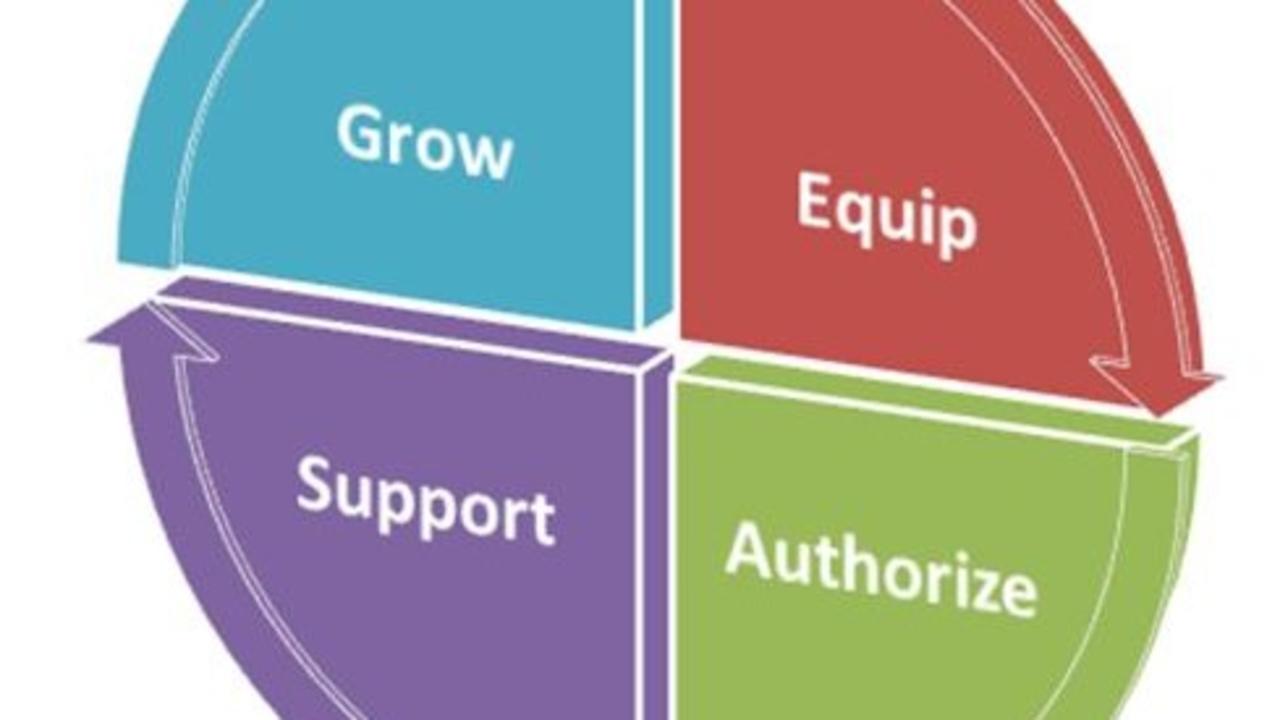
The Empowerment Cycle
By Bob Maksimchuk
Empowerment is a word we hear bandied about freely. But what does this mean? Most people struggle to explain it. When asked the more important question of how you empower people, you usually hear a very short, shallow answer such as you just give them a challenging assignment. Either that or you hear crickets.
However you want to define it, it’s more important to understand how you empower people. Empowerment is a process and this process has four mandatory components. If any of these are missing, the result will simply be failure. Here you see the Empowerment Cycle.©

It’s the repetitive, iterating, full cycle process for enabling people to incrementally increase their autonomy so that they can independently and responsibly achieve their goals. Now let me repeat that.
...Empowerment is the repetitive, iterative, full cycle process for enabling people to incrementally increase their autonomy so that they can independently and responsibly achieve their goals.
The Leadership and Communication Lessons of Josey Wales – Part 3

The scene: Josey and his injured young rebel friend furtively approach a river crossing. There they meet three very interesting people – the boatman, Sim Carstairs, who ferries people across the river, Granny Hawkins, who provides supplies and “poultices” to travelers, and a fastidious carpetbagger, wearing a white suit, selling bottles of a cure-all elixir. It is these new characters, not Josey, that teach us a few interesting leadership and communication lessons.
Depending on your point of view, Sim is either a brilliant businessman or a snake in the grass. He tells a carpetbagger who is waiting to cross the river, “In my line of work you got to be able to whistle either the Battle Hymn of the Republic or Dixie with equal enthusiasm, depending upon present company.” Which would you think he is?
Lesson 6: Communication is Received Best When You Talk to People in THEIR Language.
You see these issues every day when you talk with specialists: physicians, auto mechanics, eve...
The Leadership and Communication Lessons of Josey Wales – Part 1

By Bob Maksimchuk
Sometimes you can learn important lessons from unconventional sources. If you are unaware, the classic 1976 movie western The Outlaw Josey Wales, set near the end of the U.S. Civil War, was directed by and starred Clint Eastwood, who played the main character Josey Wales. The writers may not have intended it; however this movie is replete with leadership and communication lessons that are applicable to executives, project managers, team members, or any of us especially in difficult times on our projects. You currently may not be in a leadership position but some day may need to lead. All of us do need to effectively communicate with those that we work with. You often hear the lament that technical people need to develop “soft skills”. So let’s see what we can learn from Josey Wales and hopefully have some fun along the way.
[Spoiler alert: This series will incrementally reveal the plot of this movie. If you have not seen the movie (Where have you been?...
